

When Sony showed off their PlayStation to developers in 1993, it’s said that it left the exclusive invite list stunned. The now-famous T-Rex real-time tech demo was, indeed, so cool that it would eventually be included on consumer demo discs, including the fabled Demo 1. PS1 was a giant leap in graphics power, and Sony’s work with Psygnosis before launch ensured that developers could unlock much of this power from day one.
Read More: PlayStation 1 Classics Forgotten for One Reason or Another
However, there was still plenty of room for developers to wow gamers. Some of the console’s later games were almost unimaginable in 1995. The progress made over its life is a testament to the genius of its games’ programmers and the vision of the console’s hardware designers. And to celebrate these feats, TechStomper has picked five games, one per every full year the PS1 was king for developers, that track this progress.
Ridge Racer (1994/5)
When Ridge Racer arrived as a launch title for PS1 in all regions during its 1994 and 1995 release, it served as a showcase for what could be achieved with dedicated 3D 32-bit machines compared to ageing 16-bit machines. More importantly to the course of video games history, it was a demonstration of Sony’s hardware versus Sega Saturn. Daytona USA was a poor arcade port, ran at 20 frames per second, and had jarring pop-in right in the player’s face.

Ridge Racer‘s PS1 conversion inevitably made compromises in its graphics, but it was far closer to its arcade base than Saturn’s flagship racer.
Read More: Five PS1 Racing Games Still Worth Playing – Arcade Edition
PS1’s Ridge Racer‘s texture-mapped 3D environments were more complex and detailed than its rival. Namco’s home conversion presented a far greater sense of physical space than Sega’s home port of Daytona USA. The trackside scenery and city skyline all whizzed by with a convincing sense of speed that Saturn seemed incapable of.
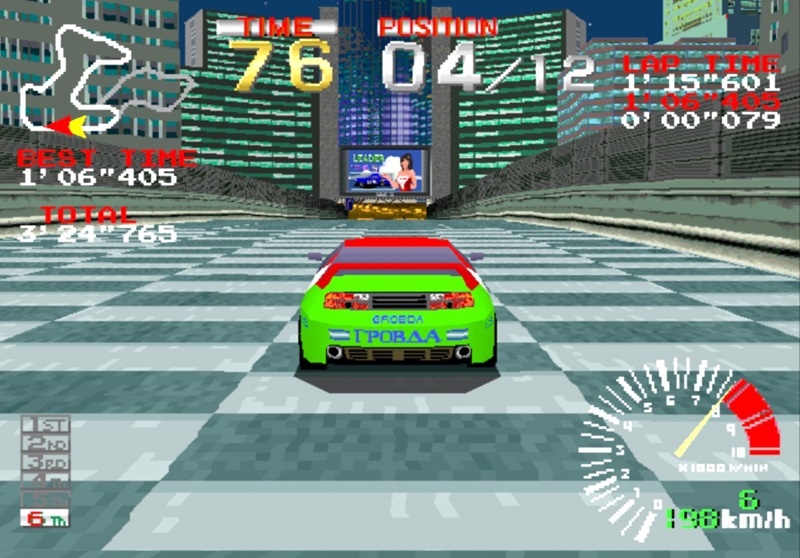
The game blew gamers away upon launch, but certain limitations would quickly became apparent. Pop-in, though much better than in Saturn’s Daytona, was still noticeable, and PlayStation’s lack of hardware perspective correction produced a warping effect on textures as they approached the camera at an angle. Later games would make attempts to mask these issues, of course.
Tomb Raider (1996)
By 1996, developers had begun to understand the PlayStation’s strengths and weaknesses. Tomb Raider was part of the second wave of PS1 software that demonstrated far more ambitious graphics and presentation. Core Design built the game around a fully 3D world composed of interconnected rooms. Each was constructed from a grid-based system that allowed for complex verticality. This approach enabled environments that felt vast and explorable, with towering caverns, ancient ruins and underwater passages.

Silent Hill would be acclaimed in later years for using fog to create atmosphere while masking short draw distance. But, Tomb Raider used a similar diegetic visual obstruction to do the same. The game’s environments would fade into darkness as the rendering limit was reached, mimicking what you would expect in dark, dingy tombs, caves and mines.
Read More: Five PS1 Classics Best Enjoyed on Other Platforms
Lara Croft’s character model was limited to around 230 polygons, but shading rounded off her torso, arms, and legs. Lara’s smooth and comprehensive animations also masked the modest polygon budget afforded her. These acrobatic manoeuvres, from handstands to swan dives, were key-framed rather than motion-captured, but they still served as a showcase for the PlayStation’s capacity for smooth skeletal animation. Indeed, Core Design’s painstakingly key-framed animation, with literally thousands of frames of bespoke animation, has aged far better than primitive motion-captured animations from around the same time.

Texture warping, geometric seams and incorrect polygon sorting were still readily visible, and textures could appear blocky when viewed up close, yet the overall presentation was cohesive enough to immerse players in a cinematic adventure. Tomb Raider showed that PlayStation could deliver not just speed and shallow spectacle but also scale and complexity.
Gran Turismo (1997)
Gran Turismo represented a watershed moment for PS1 graphics in 1997. Polyphony Digital produced a racing simulation that looked astonishingly detailed for the time. The cars were constructed from significantly higher polygon counts than earlier racers, with carefully applied textures that captured manufacturer-specific details.

Reflections and shading techniques were used to give each vehicle a sense of weight and materiality. Although the PlayStation lacked sophisticated real-time hardware lighting, Polyphony simulated it convincingly through clever texture work and pre-baked shading. Gran Turismo also used environment mapping to give the cars their dynamic sheen. The result was a level of realism that surpassed anything previously seen on the console.
Read More: Is Gran Turismo (PS1) Still Worth Playing Decades Later?
The tracks were equally impressive. While still subject to pop-in and the familiar texture distortion, they featured more varied scenery, smoother curves and more convincing elevation changes than earlier titles. The game also featured a little environmental LoD to stretch the draw distance a little further. You can see low-polygon, low-quality textures just at the edge of the rendering area, in particular along the track where gamers are spying the next corner.

The frame rate was capped at 30 frames per second, and it remained stable enough to maintain immersion. Gran Turismo signalled a shift towards simulation-level detail, and heralded AAA title’s pivot to authenticity over stylised abstraction. Many games would follow that lead and photorealism became the goal of many AAA titles later in the PS1’s life.
Metal Gear Solid (1998)
By 1998, PS1 graphics strengths and limitations were well understood. But, Metal Gear Solid managed to present a cinematic experience beyond what many thought the hardware to be capable of. The real-time character models were relatively simple, but their expressive body animations and distinctive silhouettes made them memorable.

Facial detail was minimal, yet the game relied on body language, voice acting and camera work to convey emotion. This approach allowed the PlayStation to deliver a narrative-driven experience without overextending its technical resources.
Read More: Metal Gear Solid: Master Collection Vol. 1 review – Whole Pieces of History
The game’s use of lighting, pseudo-particle effects and colour was particularly effective. Snowstorms, searchlights and interior shadows all contributed to a sense of place that felt grounded and believable. The camera angles, inspired by film and television, masked low polygon counts and texture limitations.

Codec conversations used stylised portraits rather than attempting full-motion facial animation, a choice that preserved clarity while avoiding technical pitfalls. Metal Gear Solid demonstrated that the PlayStation could deliver a sophisticated, cinematic presentation through intelligent design rather than brute-force graphical power.
Driver (1999)
Driver was a bit of a shock to gamers in 1999, few could have imagined in 1995 that the PlayStation could deliver drivable cities inside its paltry RAM. Reflections’ solution was to stream certain assets straight from the disc as players travelled the maps. The scale of Driver‘s cities represented a huge technical achievement that wowed gamers and the press alike. Pixelated textures, repetitive scenery, and poor draw distance were seen as necessary compromises to the graphics to bring something of its kind to PS1.

Driver used crudely edited and processed photographs as textures across much of its cityscapes. This saved time handcrafting bespoke assets and also added to the sense of place within the game. Admittedly, it does give the game a garish look in many places, but it shows how far PS1 developers had moved away from the cartoonish or impressionist visuals that defined its earlier years.
Read More: Is Driver (PS1) Still Worth Playing Decades Later?
Every so often Driver will surprise you with some neat effect or visual flair. The rain effects, your hubcaps flying off in the heat of the chase, or the environment mapping on the vehicles. There are tons of little visual effects that add much to the presentation.

The damage modelling was another advanced effect that elevated Driver. It’s still cool to watch debris stream from a crash and see the subsequent damage on your car. There are also boxes, barrels and traffic cones to obliterate, mirroring the car chase scenes it so devotedly references throughout. Performance hovers around the mid‑20s, dipping when the engine has to juggle multiple AI cars and large intersections, but the sensation of speed is maintained through smart camera shake and motion cues.
